
At a glance
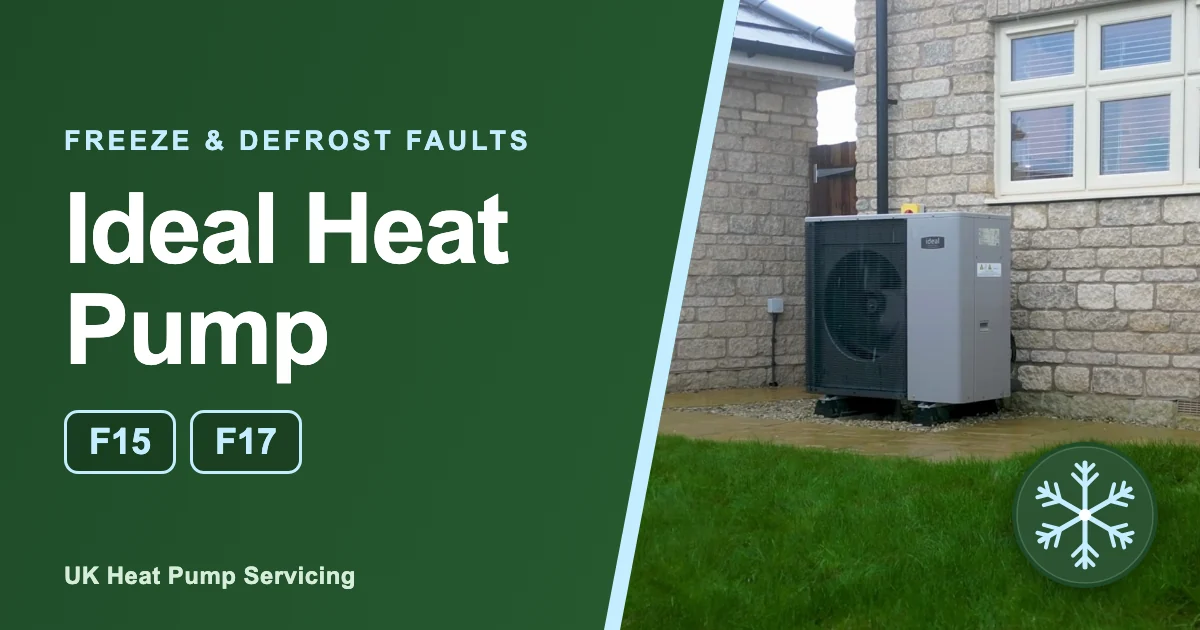
- On an Ideal Logic Air heat pump, fault 370 means a heat pump fault, and the sub-code tells you which: F15 is a heat pump air flow fault and F17 is a heat pump fan fault.
- Ideal’s user guide says a defrost should last a few minutes, that steam and more water than usual are normal during it, and that de-icing happens more often around 2.5 °C and less often below 0 °C.
- A fault shows as a number with a bell icon on the Logic Air control box on the cylinder; turning the wheel to the bar graph opens the Info screen with the full code, for example 370 F15.
- Ideal’s pressure range is 1 to 1.5 bar, refilled through the filling loop if it drops under 1 bar.
- Ideal’s reset is to turn off the rotary isolator near the outdoor unit, leave it off for one minute, switch it on and allow a few minutes to boot.
- Frost protection on the Logic Air runs the circulator continuously at or below 1 °C outdoors and starts the backup heater if primary water drops to 4 °C, but only while the heat pump has power.
What do 370 F15 and F17 mean on an Ideal heat pump?
Fault 370 on an Ideal Logic Air means the outdoor heat pump unit has reported a problem, and the F sub-code identifies it: F15 is a heat pump air flow fault and F17 is a heat pump fan fault. Both come from the fault table in Ideal’s Logic Air user guide, and both are the codes an iced-up outdoor unit tends to produce, because ice on the coil chokes the airflow and ice on the blades stalls the fan.
Ideal’s own brochure adds a useful caution: error 370 indicates a fault with the outdoor unit “but this can also be due to poor flow rate”, so a 370 with F27, the no water flow sub-code, is a water problem rather than an air one. The control box shows a bell at the top of the screen when a fault is present; turn the wheel to highlight the bar graph and the Info screen shows the full code.
The Logic Air system is controlled from the Logic Air Control Box mounted on the cylinder and the Halo Air thermostat in the house, so you may notice the house cooling before you see the bell. If the heat pump has stopped with no code, our guide to a Heat Pump Not Working explained covers the first checks; every other Logic Air code is in our Ideal heat pump error codes guide.
Is ice on an Ideal heat pump normal?
Yes, and Ideal says so in plain terms. The Logic Air user guide explains that frost forms on the outdoor unit in cold weather, that the unit runs a defrost cycle lasting a few minutes to clear it, and that during the defrost “a plume of steam may be visible” along with more water than usual from the base. The brochure adds that around 2.5 °C the de-icing cycle happens more often, and less often when the air is below 0 °C because it is drier.
Ideal also warns that the fan and compressor change speed as conditions change, so a shift in the noise level and tone of the unit is normal rather than a sign of trouble. What is not normal is ice that outlasts the defrost, a fan that is visibly iced in, or a 370 F15 or F17 that keeps returning.
Ideal’s guide is direct about the cause it can see: leaves or snow could jam the heat pump and affect its operation, and anything restricting airflow should be removed immediately. For a brand-neutral picture of frost versus a fault, see our guide to a Heat Pump Frozen Outside Unit guide.
How does the Ideal defrost cycle work?
The Ideal Logic Air defrosts by reversing its refrigerant circuit for a few minutes so the outdoor coil warms and sheds its frost, drawing that heat from the primary water in the system. The defrost thermistor on the coil, which has its own sub-code (370 F9), tells the controller when the coil is clear. Melt water runs through the condensate drain openings in the base panel, and Ideal warns about frozen condensate on walkways, which is why the drain path matters.
Ideal’s documents do not state that the fan stops during a defrost, so the sequence of fan pause and steam that owners describe is general heat pump behaviour; our guide to the Heat Pump Defrost Cycle guide explains it. What the Logic Air guide does spell out is its layered frost protection, which is separate from defrost:
- Plant frost protection: at or below 1 °C outdoors the circulator runs continuously; between 1 and 5 °C it runs intermittently.
- Condenser frost protection: if primary water in standby falls to 4 °C the pump starts, and the backup heater raises it to 22 °C.
- Dwelling frost protection: the system keeps the house above 8 °C.
Every one of these needs the heat pump to have power, which is why Ideal recommends not switching the system off completely in winter.
Why has my Ideal heat pump frozen or shown F15 or F17?
A Logic Air freezes when air cannot move through the outdoor coil or when the water side cannot supply enough heat for a defrost. The table pairs the codes Ideal lists with the winter cause usually behind them.
| Symptom | Logic Air code | Cause | Who acts |
|---|---|---|---|
| Ice on the coil, poor heat, bell icon | 370 F15 | Air flow fault: snow, leaves or ice choking the coil; failed defrost | Owner clears the unit from outside, then engineer if it returns |
| Fan stopped or iced in | 370 F17 | Fan fault: blades locked by ice or debris, or a motor failure | Owner clears debris, engineer if the fan stays still |
| Frost not clearing between cycles | 370 F9 | Defrost thermistor fault | Engineer |
| Unit stops, radiators cold | 370 F27 | No water flow: blocked system filter or air in the primary pipework, per Ideal’s brochure | Owner checks pressure and valves, then engineer |
| Unit stops in heating | 370 F20, 370 F14 | Outdoor low pressure or pressure sensor fault; iced coil or refrigerant loss | Engineer |
| Repeated 370 faults | 134 | Re-occurring heat pump fault | Engineer |
| Outside temperature reading wrong | 10 | Outside sensor fault | Engineer |
Pressure sits underneath several of these rows, because a system below 1 bar loses flow and the defrost loses its heat source. If your gauge keeps dropping, read our guide to the Ideal heat pump 370 F27 and AE low water pressure faults.
How do I clear an Ideal freeze fault safely?
Ideal’s user guide gives owners more to work with than most, including a reset. Follow the steps in order and stop at the casing.
- Read the full code. On the Logic Air control box, turn the wheel to the bar graph to open the Info screen and note the 370 sub-code, F15, F17 or another.
- Keep the power on. Plant, condenser and dwelling frost protection all stop if the heat pump loses power, so do not leave the isolator off.
- Clear leaves and snow. Ideal says to remove anything restricting airflow immediately. Work by hand or with a soft brush from outside the unit, and keep the general clearances from the installation manual.
- Clean gently if needed. Ideal allows a weak soap spray solution only, and warns that hose pipes or high-pressure washers damage the unit. Never pour hot water on the coil.
- Check the condensate openings. Make sure melt water can leave the base panel and is not freezing on a path. Thaw a frozen outlet with lukewarm water, keeping it off the fins.
- Check pressure, then reset once. Ideal’s range is 1 to 1.5 bar, topped up through the filling loop if under 1 bar. Then follow Ideal’s reset: rotary isolator off for one minute, back on, and a few minutes to boot. If the code returns, book an engineer.
Do not chip ice from the fan or fins, do not open the outdoor unit’s panels and never touch the refrigerant pipework. Sub-codes F20 and F14 sit on the sealed refrigerant side, which only a qualified engineer may work on.
When to call an engineer
Call an engineer if 370 F15 or F17 returns after Ideal’s one-minute reset, if the fan will not turn with nothing blocking it, if the coil is still iced several hours after you cleared around the unit, if 370 F20 or F14 appears, or if fault 134 shows because the heat pump fault keeps recurring. Call straight away if the house has no heating or hot water in freezing weather, or if pressure keeps falling below 1 bar after a top-up.
An engineer will test the fan motor, check the defrost thermistor, clean the system filter and purge air behind F27, verify pressure and flow, and check the refrigerant charge if F20 is in the history.
UK Heat Pump Servicing provides annual servicing, fault diagnosis and repair, cover plans and new installations for heat pump owners across England, Scotland and Wales. Book an Heat pump repairs, compare service and cover plans, or check the the towns and cities we cover.
How can I stop my Ideal heat pump icing up again?
Keeping a Logic Air clear through winter is mostly about airflow and water. Clear leaves every autumn, keep snow off the coil and the condensate openings, and leave the clearances in the installation manual free of bins, pots and plants. On the water side, a clean system filter and pressure held at 1 to 1.5 bar give the defrost the flow it needs. An annual service covers the filter, pressure, fan and defrost thermistor, and our article on Why Heat Pump Servicing Is So Important explained explains what each check prevents.
Ideal’s guide also recommends not turning the system off completely in winter, because frost protection is lost without power. Our guide to Do Heat Pumps Work in Cold Weather explained explains why steady running beats switching off, and if you want winter faults covered under a plan, read whether Is Heat Pump Cover Worth It explained for your system.
Frequently asked questions
Can I cover my Ideal Logic Air outdoor unit in winter?
Not with a wrap or tarpaulin. The Logic Air needs free air through the coil to heat and to defrost, and a cover is a quick way to bring on 370 F15. Ideal asks for the clearances in its installation manual to be respected, so any canopy to keep roof snow off must leave the air inlet and outlet open. Ask your installer before fitting one.
Why is the fan running but the unit still icing up?
A turning fan does not prove air is getting through the coil, because ice or packed leaves on the fins can block it while the blades spin. A failed defrost thermistor (370 F9) or a water flow problem (370 F27) can also let ice build with the fan working. If the coil stays white after a defrost, book an engineer.
Does the 370 code clear itself once the ice has gone?
Sometimes, but Ideal’s guide gives a reset for a reason. Clear the unit, check the pressure is between 1 and 1.5 bar, then turn the rotary isolator off for one minute and back on. If the bell and the code return after the system boots, the cause is still there and an engineer needs to find it.
Why does my Logic Air defrost so often on a damp day just above freezing?
Because that is where frost forms fastest. Ideal’s brochure says de-icing happens most often around 2.5 °C and less often below 0 °C, when the air holds less moisture. Frequent short defrosts on a raw, misty day are the unit working as designed, not a fault.
Will the backup heater keep the house warm if the outdoor unit is iced?
The Logic Air’s backup heater is part of its frost protection and will raise cold primary water to 22 °C, and depending on settings it can support heating while the heat pump is out. It uses more electricity than the heat pump, so treat it as a stopgap while the fault behind the icing is fixed.
Sources and further reading: Ideal Heating, User Guide, Logic Air Monobloc Heat Pump System, June 2024, UIN 235468 A07, fault table and frost protection sections (idealheating.com); Ideal Heating Logic Air Guide Brochure Rev B (customer brochure, read from a retailer-hosted copy, oceanairuk.com).