
At a glance
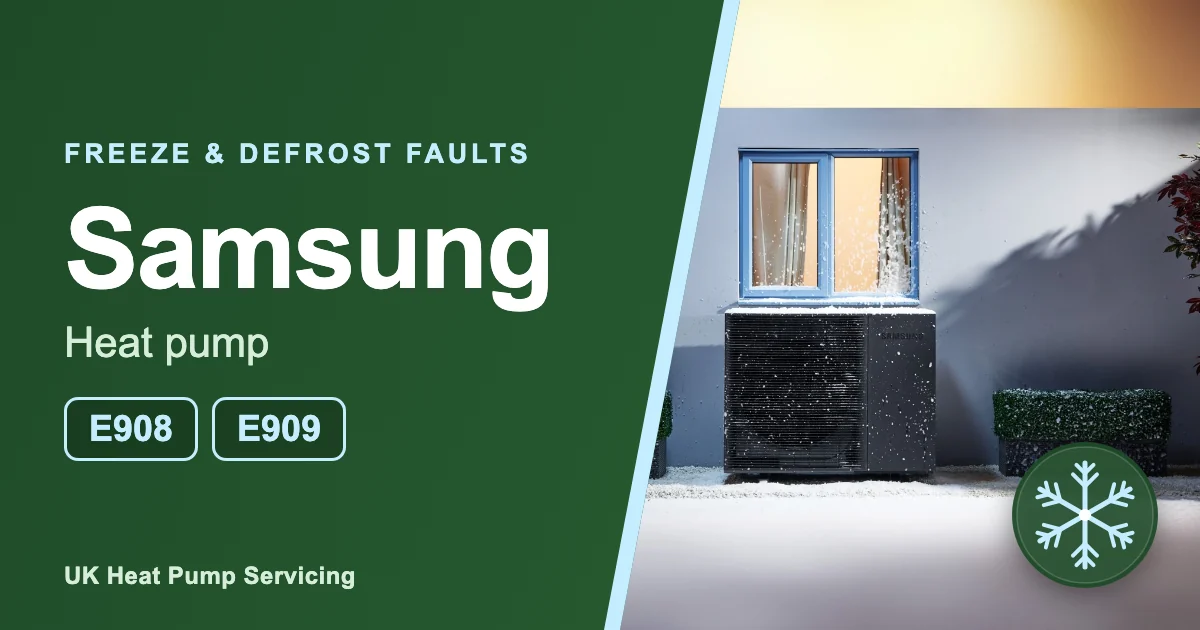
- E908 on a Samsung EHS hydro unit means “Error due to freeze prevention (Re-operation is possible)”; E909 means “Error due to freeze prevention (Re-operation is impossible)”.
- Samsung’s installer guide warns that its freezing protection, which runs the pump at low temperatures, cannot be relied on during a power failure, and asks for glycol in the water or an anti-freeze valve, never both.
- E436 is plate heat exchanger freeze detection during heating; E403 is the same detection during cooling.
- Samsung requires at least 150 mm of free space under the outdoor unit and a drain that cannot be blocked, because inadequate drainage leads to stagnant water and ice build-up.
- E908 and E909 appear in the wired remote controller (MIM-E03EN) code list but not in the newer EHS Mono R32 and R290 outdoor unit tables, so they apply to particular hydro units.
- Samsung gives no cause list and no owner reset for these codes; a locked E909 is engineer work.
What does E908 or E909 mean on a Samsung heat pump?
E908 and E909 are the freeze prevention errors in the Samsung EHS hydro unit code list. The MIM-E03EN control kit manual describes E908 as “Error due to freeze prevention (Re-operation is possible)” and E909 as “Error due to freeze prevention (Re-operation is impossible)”, with the hydro unit as the source of both. In plain terms, E908 is the hydro unit telling you it stopped to protect its water from freezing and will try again; E909 is the same protection, but the unit has decided it cannot safely restart on its own.
Samsung’s manuals give the descriptions only. There is no cause list and no reset procedure for either code, so the reasons later in this guide are drawn from how freeze prevention trips on any air to water heat pump: water that is too cold and too slow through the plate heat exchanger while the refrigerant side is running cold.
Note the scope. E908 and E909 are in the wired remote controller’s list, but the installer reference guides for the EHS Mono R32 (AE050RXYDEG and related) and the R290 AE050CXYDEK do not list them in their outdoor unit tables, so the codes you see depend on the hydro unit fitted. If the heat pump has stopped with no code, our guide to a What to know about Heat Pump Not Working covers the first checks; for every other code see our Samsung heat pump error codes guide.
Is ice on a Samsung heat pump normal?
Frost on the outdoor coil of a Samsung EHS is normal in cold, damp weather. Samsung’s installer guide says the system occasionally enters a defrost mode and the ice on the surface thaws off, and that water dripping from the condenser is guided out through the drain holes in the base. That is the unit working as designed, and it needs the drain to be clear to do it.
What Samsung treats as a problem is water that cannot leave. Its drainage section warns that if the drainage is not adequate it can lead to stagnant water and ice build-up, and asks installers to make sure dirt and debris cannot block the drain or hose and to clean the base plate whenever needed. A Samsung outdoor unit standing in its own frozen melt water is the commonest “frozen Samsung” our engineers see, and it starts at the drain, not the coil.
Ice that encases the fan or sheets across the coil after a defrost is a different fault; our guide to a Heat Pump Frozen Outside Unit questions answered shows what that looks like and what not to do about it.
How does the Samsung defrost cycle work?
The Samsung EHS defrosts by reversing its refrigerant circuit so the outdoor coil warms and sheds its frost, drawing that heat from the water in the hydro unit. Samsung’s guide confirms the defrost mode and the drain path but does not describe fan behaviour, steam or duration, so those details are general heat pump behaviour; our guide to the Heat Pump Defrost Cycle questions answered covers them.
Because a defrost takes heat from the water, Samsung pairs it with freeze prevention on the hydro unit, which is where E908 and E909 come from, and with plate heat exchanger freeze detection: E436 in heating and E403 in cooling. The R290 generation labels the same pair “Protect for Freezing Burst Control Error” and “Protect for Freezing Control Error”. All of them watch the water temperature at the plate heat exchanger and stop the compressor before ice can form.
Samsung’s installer guide is clear about the limits. The freezing protection function includes activation of the pump at low temperatures, but in a power failure those functions cannot protect the system, so Samsung asks for either glycol in the water or an anti-freeze valve fitted, and states that if glycol is added the anti-freeze valve must not be installed. That is the single most useful thing to know about a Samsung in a frost: keep it powered, and know which protection your installer chose.
Why has my Samsung heat pump frozen or shown E908 or E909?
Freeze prevention trips when the hydro unit’s water is cold and barely moving. Samsung lists no causes, so the table pairs its codes with the usual reasons our engineers find behind them.
| Symptom | Samsung code | Likely cause | Who acts |
|---|---|---|---|
| Hydro unit stops, then restarts | E908 | Freeze prevention, re-operation possible: brief low flow or low return temperature overnight | Owner checks valves and pressure |
| Hydro unit stops and stays stopped | E909 | Freeze prevention, re-operation impossible: persistent low flow, loss of water, air, or a cold system after a power cut | Engineer |
| Compressor stops in heating | E436 | Plate heat exchanger freeze detection during heating; low flow or low refrigerant | Engineer |
| Flow switch opens with the pump running | E911 | Blocked strainer, closed valve, air lock or low pressure | Owner checks pressure and valves, then engineer |
| Pipe rupture protection | E907 | Water temperature or pressure outside safe limits; check for leaks | Owner checks the gauge, then engineer |
| Outdoor fan not running | E915, E441, E475, E458 (R290) | DC fan or fan 1 and fan 2 errors; ice or debris on the blades in winter | Owner clears debris, then engineer |
| Ice growing under the unit | None | Blocked drain holes; Samsung warns of stagnant water and ice build-up | Owner clears debris, engineer if the base plate needs cleaning |
Low pressure is the quiet cause under E908, E909 and E911. If your gauge is low or E911 keeps appearing, our guide to Samsung EHS E911 and E912 low water pressure explains what to check and when to top up.
How do I clear a Samsung freeze fault safely?
Samsung publishes no owner reset for E908 or E909, so these checks are about removing the conditions behind the trip and letting E908 recover on its own.
- Record the code. Note whether the wired remote controller shows E908 or E909, and any companion code such as E911 or E436, with the time.
- Keep the power on. Samsung’s freezing protection runs the pump at low temperatures only while the unit is powered. Isolating it in a frost removes the protection.
- Open every valve. Check that the isolation valves on the hydro unit, zone valves and radiator valves are open, so water can move through the plate heat exchanger.
- Check the pressure. If the gauge is below the range your installer marked, top up if your system has a filling loop. Repeated top-ups mean a leak that needs an engineer.
- Clear the outdoor unit and its drain. Working from outside, remove snow and leaves, make sure the 150 mm gap under the unit is open and that the drain holes are not blocked. Thaw a frozen outlet with lukewarm water only, away from the fins.
- Give E908 time; do not force E909. E908 allows re-operation, so the hydro unit will restart once the water warms. E909 does not, and repeated power cycling to clear it risks a frozen heat exchanger.
Do not chip ice from the coil, pour hot water over it, or remove panels from the hydro unit or outdoor unit. The refrigerant circuit, including the low charge that can sit behind E436, is restricted to qualified engineers.
When to call an engineer
Call an engineer straight away for E909, and for E908 if it returns after you have opened the valves and checked the pressure. Call too if E436 or E911 appears with the freeze codes, if the outdoor unit stays a block of ice after a defrost, if the fan will not turn, if water is leaking, or if heating or hot water has stopped in freezing weather.
An engineer will measure the flow through the hydro unit, clean the strainer, purge air, check the glycol concentration or anti-freeze valve that Samsung requires, test the plate heat exchanger for freeze damage after an E909, and check the refrigerant charge if E436 is in the history.
UK Heat Pump Servicing provides annual servicing, fault diagnosis and repair, cover plans and new installations for heat pump owners across England, Scotland and Wales. See our Samsung heat pump servicing and repairs page, book a a repair engineer visit, compare a heat pump service plan or find the local heat pump engineers.
How can I stop E908 and E909 coming back?
Freeze prevention trips are prevented by the things Samsung’s installer guide asks for: water that moves, a drain that cannot block, and a frost margin from glycol or an anti-freeze valve. An annual service checks the strainer, pump, pressure and glycol strength, cleans the base plate and tests the defrost; our article on Why heat pump servicing is so important in detail explains how each check stops a winter call-out.
Settings matter too. Samsung’s own troubleshooting for a space not heating sufficiently at low outdoor temperatures points to an immersion or backup heater that is switched off or has tripped its thermal cut-out, heater settings, air in the system and hot water priority. Keeping the backup heater enabled gives the hydro unit a way to warm the water when the compressor cannot. Our guide to Do heat pumps work in cold weather in detail explains why steady running protects the system, and if you want winter faults covered, read whether what to know about Is Heat Pump Cover Worth It. Our Samsung heat pump review looks at the EHS range as a whole.
Frequently asked questions
Can I leave my Samsung heat pump running with E908 showing?
Yes. E908 is freeze prevention where re-operation is possible, so the hydro unit will restart once its water is warm enough. Keep it powered, open any closed valves, check the pressure and watch whether the code returns. A repeat on the next cold night means the flow problem behind it is still there, and an engineer should find it before it becomes E909.
Does E909 mean my Samsung heat pump is damaged?
Not necessarily. E909 is freeze prevention where re-operation is impossible, which is a lockout rather than a damage report. An engineer will check the plate heat exchanger and pipework for freeze damage before restarting, because a hydro unit that locked out in a hard frost may have come close to freezing solid.
Why is my house cold in a cold snap when there is no code?
Samsung’s installer guide links a space not heating sufficiently at low outdoor temperatures to a backup heater that is off or has tripped, incorrect heater settings, air in the system, and capacity going to hot water. None of those raises a freeze code, and an engineer can reset the thermal cut-out, purge air and correct the settings in one visit.
Should my Samsung system have glycol or an anti-freeze valve?
One or the other, never both. Samsung’s guide asks installers to add glycol to the water or install an anti-freeze valve, and states that if glycol is added the anti-freeze valve must not be fitted. Ask your installer which was chosen, because weak glycol or a missing valve leaves the outdoor pipework exposed during a power cut.
Why does my Samsung outdoor unit sit on a stand?
Because Samsung requires at least 150 mm of free space between the unit and the floor, so defrost water can leave through the drain holes and cannot refreeze under the unit. Samsung’s drainage section warns that inadequate drainage leads to stagnant water and ice build-up, so a unit sitting on the ground is a frozen unit waiting to happen.
Sources and further reading: Samsung MIM-E03EN air to water heat pump control kit manual, error code list (read as a manualslib copy of the official manual, manualslib.com); Samsung EHS Mono AE050RXYDEG/EU Installer Reference Guide Book, R32, drainage, freeze protection and troubleshooting sections (manualslib copy, manualslib.com); Samsung EHS Mono AE050CXYDEK Installer Reference Guide, R290, error code table (manualslib copy, manualslib.com).